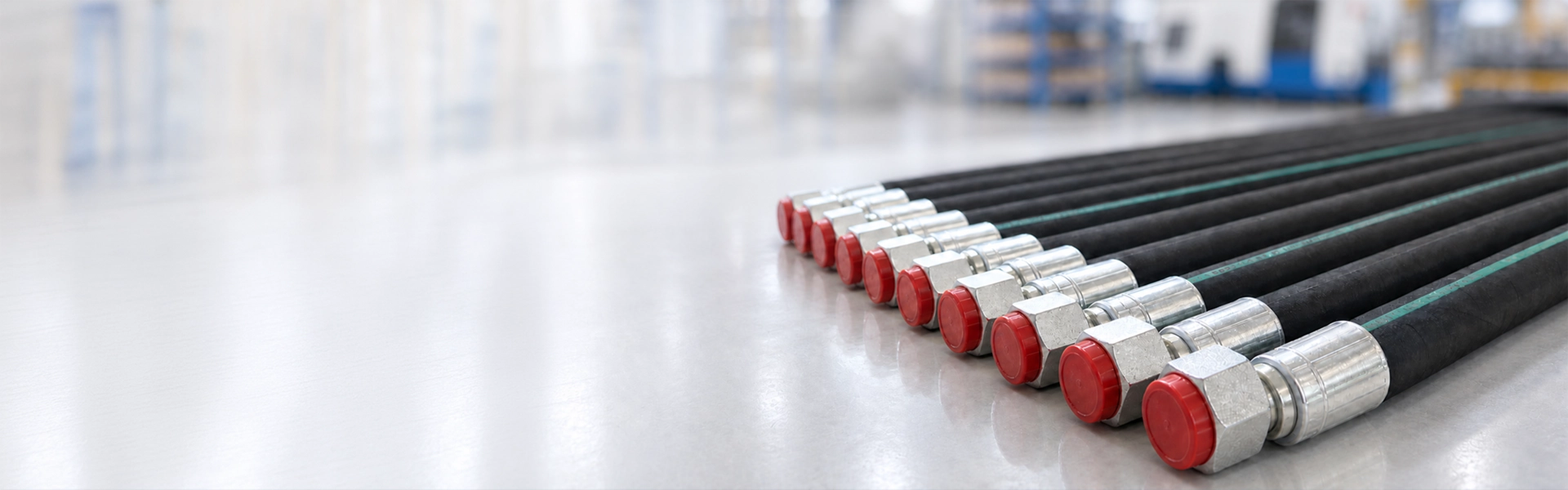

ZIODE Hydraulic hoses are critical to hydraulic system performance, enabling efficient and reliable transfer of hydraulic energy. They are widely used in machinery such as machine tools, excavators, and presses. Given their importance, hydraulic hoses must meet strict quality control standards. Every hose is fully tested and inspected before delivery to ensure safe, durable, and stable operation.
We welcome you to join our inspection process and personally verify the quality and reliability of your hydraulic hoses.
-
Check inner/outer diameter and length per SAE J517 (e.g., ID ±0.5 mm).
-
Measure with calipers or laser tools to match drawings.
-
Verify minimum bend radius is within limits.
-
Inspect connector threads, dimensions, and crimping quality.
Apply a test pressure of 1.5 times the working pressure (e.g., 31.5 MPa for a 21 MPa working pressure) and hold for 2 minutes to confirm no leakage occurs.
This test simulates real world pressure fluctuations and conducts tens of thousands of pressure cycles to assess the fatigue life of hydraulic hoses.
Sample & Equipment Preparation
-
① Take 3 or more hose samples from the same batch.
-
② Prepare a pulse pressure testing machine.
-
③ Crimp connectors per standards (SAE, DIN, ISO, etc.) and ensure qualified crimping.
Test Parameter Settings
-
① High pressure: 125%–133% of rated working pressure (e.g. 26–28 MPa for 21 MPa WP)
-
② Low pressure: 10%–20% of maximum pressure (e.g. 2–5 MPa)
-
③ Pulse frequency: 0.5–1.5 Hz (commonly 1 Hz = 60 cycles/min)
-
④ Oil temperature: 93±3°C
-
⑤ Cycle count: 500,000 cycles (ISO 6803) or customer-specified quantity
Testing Procedure
-
① Install the hose on the test machine without twisting or excessive bending.
-
② Fill with hydraulic oil and completely vent trapped air.
-
③ Start the machine; it will automatically cycle between set high and low pressures.
Real-time Monitoring & Inspection
-
① Monitor pressure curve stability and record cycle count.
-
② Inspect for leaks, bulges, or loose joints every 50,000–100,000 cycles.
-
③ Test must reach target cycles without failure.
Post-Test Inspection
-
① Visually check for cracks, delamination, or loose joints.
-
② Perform burst pressure verification if required by standards.
Leak testing is a key quality control step for hydraulic hoses, ensuring the assembly remains sealed at rated pressure and verifying the reliability of the hose, joints, and assembly process.
-
Air Tightness Test: Pressurize with compressed air or nitrogen, then submerge in water or apply leak detection fluid to check for bubbles.
-
Hydraulic Leak Test: Inspect joints and hose body for leaks under high pressure.
Bendability test evaluates hose performance under bending, which directly affects service life and installation safety. It tests pressure resistance, kink resistance and fatigue life in bent state.
-
Minimum bend radius test: Verifies sealing performance and structural stability under specified bending radius.
-
Torsion test: Checks the hose’s ability to resist twisting during use.
During operation, hydraulic hose covers may wear from friction with external parts, ground or other hoses, which shortens service life and risks safety. Thus, abrasion testing is a key pre-shipment inspection for hydraulic hoses.
Spectrometers are used to verify that the connector material (e.g., carbon steel, stainless steel) complies with ASTM A276 standards.

网站资料更新中...
网站资料更新中... Privacy Policy